


Palermo
The clearest social reference point for bars, cafes, parks, late dinners and international-student movement, especially for students who want Buenos Aires to feel active from the beginning.
Buenos Aires is the broadest Argentina route for exchange and international students, combining major universities, visible nightlife, late social habits and enough neighborhood variety to shape very different semesters inside one city.
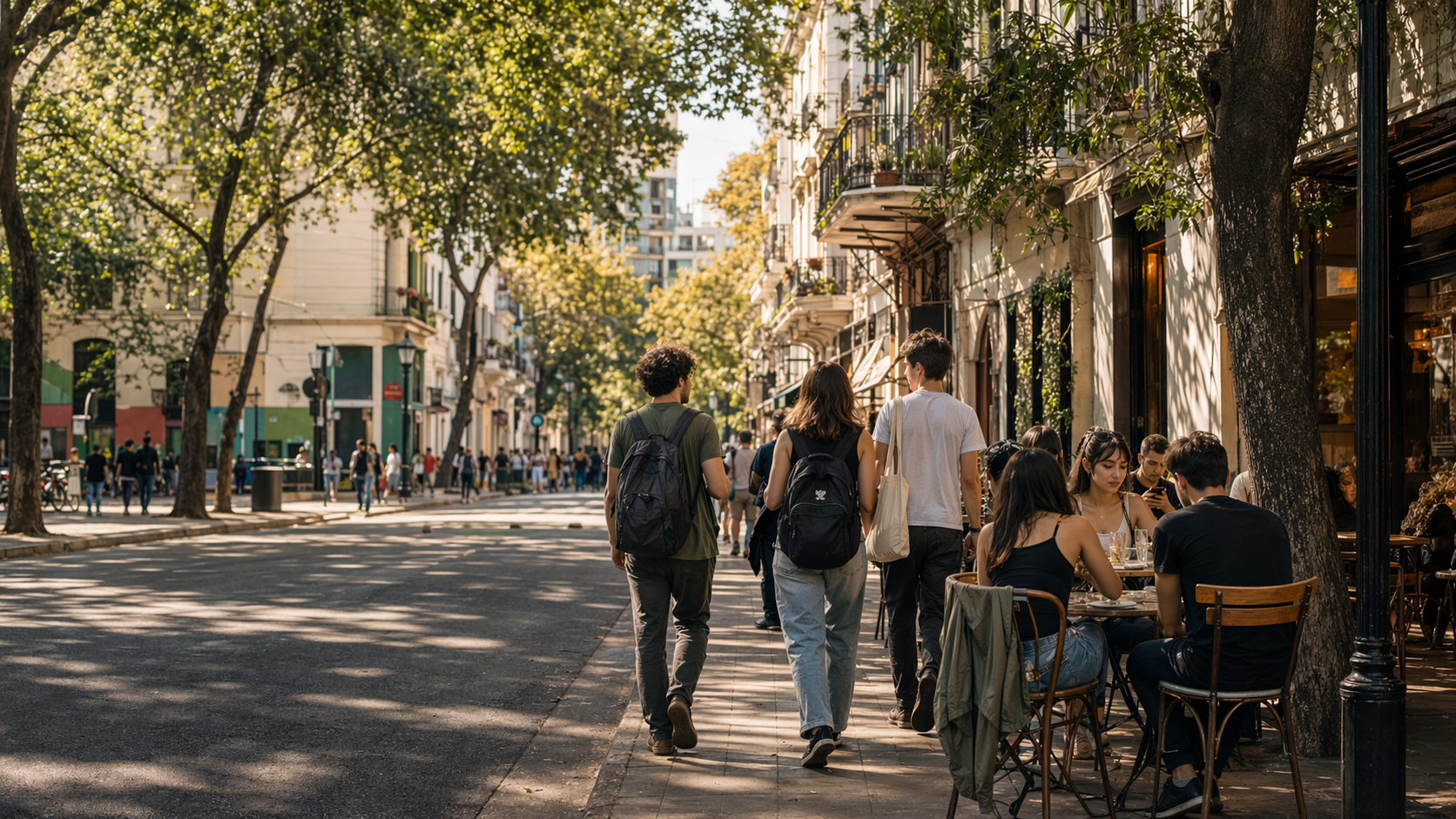
Buenos Aires works for students who want scale, visible culture and a city that feels social on the street, not only on campus. The advantage is range. The challenge is that social life is fragmented across neighborhoods, universities, nightlife, cultural spaces and local friend groups.
Most students build momentum through UBA and private-university routines, shared dinners, coffee after class, Palermo evenings, Recoleta and Belgrano meetups, San Telmo nights and the habit of turning one good invitation into repeated plans instead of endless browsing.
This page sits inside the Erasmus in Argentina guide and the Erasmus cities hub, and it links back to the Unera homepage. Before arrival, read how to meet Erasmus students and how to make friends during Erasmus. If you are comparing tools for the social side of exchange, open the Erasmus student app page too.
Buenos Aires is most useful to compare with Cordoba, Rosario and Mendoza. Cordoba feels more student-dense, Rosario more breathable and Mendoza more compact plus outdoor-oriented.
Buenos Aires gives students more social volume than any other Argentina city in the Unera cluster, but scale can become noise. The strongest semesters usually come from one campus routine, one evening routine and one weekend routine rather than trying to use every neighborhood at once.
The city works best when transport, university life and social plans start overlapping. Once you know which Subte lines, cafes, bars and plazas you actually repeat, Buenos Aires feels much less abstract and much more social.
Compared with Cordoba, Buenos Aires is larger and more fragmented. Compared with Rosario, it is denser and more international. Compared with Mendoza, it is more urban, later and less outdoor-shaped.
The clearest social reference point for bars, cafes, parks, late dinners and international-student movement, especially for students who want Buenos Aires to feel active from the beginning.
Useful for students who want a more polished and central daily routine with easier access to study spots, museums, transport and social plans.
Strong for culture, nightlife spillover and city energy, but better for students who actually like dense urban movement instead of only weekend atmosphere.
Good for students who want a calmer residential base while staying connected to universities, the river side and broader city movement.
Valuable for a more local everyday rhythm, better price logic in some cases and easier access to routines that feel less curated than the obvious international zones.
UBA is the city's main academic anchor and helps define student life through multiple faculties, broad public-university presence and a huge local student base.
These universities add a more international and centrally located private-university layer, especially useful for exchange students whose social life sits across several neighborhoods.
These institutions contribute a more specialized student profile and help broaden Buenos Aires beyond one dominant university identity.
Buenos Aires has plenty of activity, but discovery is fragmented across exchange offices, faculty groups, WhatsApp, Instagram, bars, cultural centers, concerts, football, language exchange and friend-of-friend plans.
The strongest events are usually the ones that create a second meeting: a dinner that becomes a weekly plan, a language exchange that turns into coffee, or a cultural night that leads to the same group meeting again next week.
Use big-city energy as entry, not as the full model. Buenos Aires becomes much easier once you stop trying to cover everything and start repeating what already worked once.
Buenos Aires rewards students who combine campus entry points with neighborhood continuity. Big-city social life becomes easier when repetition is designed on purpose.
Use orientation, exchange offices, class introductions and faculty groups first. They give the first names and chats that make the city feel less anonymous.
Pick two or three neighborhoods you can really use after class. For the broader process, read how to meet Erasmus students.
After one dinner or night out, suggest coffee, lunch, a park hang or a museum plan. In Buenos Aires, that move matters more than attending the next five big nights.
Unera helps reduce the friction between Buenos Aires scale and your actual social options by keeping nearby students, chats and plans visible in one place.
Nightlife in Buenos Aires is broader than clubbing. Bars, vermouth spots, live music, cultural centers, milongas, house dinners and long late-night dinners shape the real student social layer.
Palermo is the obvious reference, but many students build better routines through smaller and more repeatable areas in Recoleta, Almagro or San Telmo depending on their daily route.
The strongest Buenos Aires semesters usually mix bigger nights with many smaller plans. That is what turns the city from impressive into usable.
A cheaper room can become expensive if buses, transfers and distance kill your social energy. Pick a route you can live with every day.
Buenos Aires is the city where Argentina's price volatility is most visible. Review your budget regularly instead of trusting one number from before arrival.
Host-university paperwork, migration steps and local admin feel easier when finished early, before classes and social plans stack up.
A football plan, cafe study session, language exchange or recurring dinner is more valuable in Buenos Aires than a long list of one-off ideas.
Buenos Aires gives huge social volume but not always clarity. Unera helps you understand who is nearby and why that contact may matter.
The app reduces the usual Buenos Aires friction of too many chats, neighborhoods and half-visible plans spread across the same city.
Buenos Aires rewards repeated contact. Unera helps keep the conversation moving after the first dinner, class or language exchange.
Use Unera to discover students, find local plans and turn Buenos Aires from a huge map into a social routine you can actually use.