


Navigli
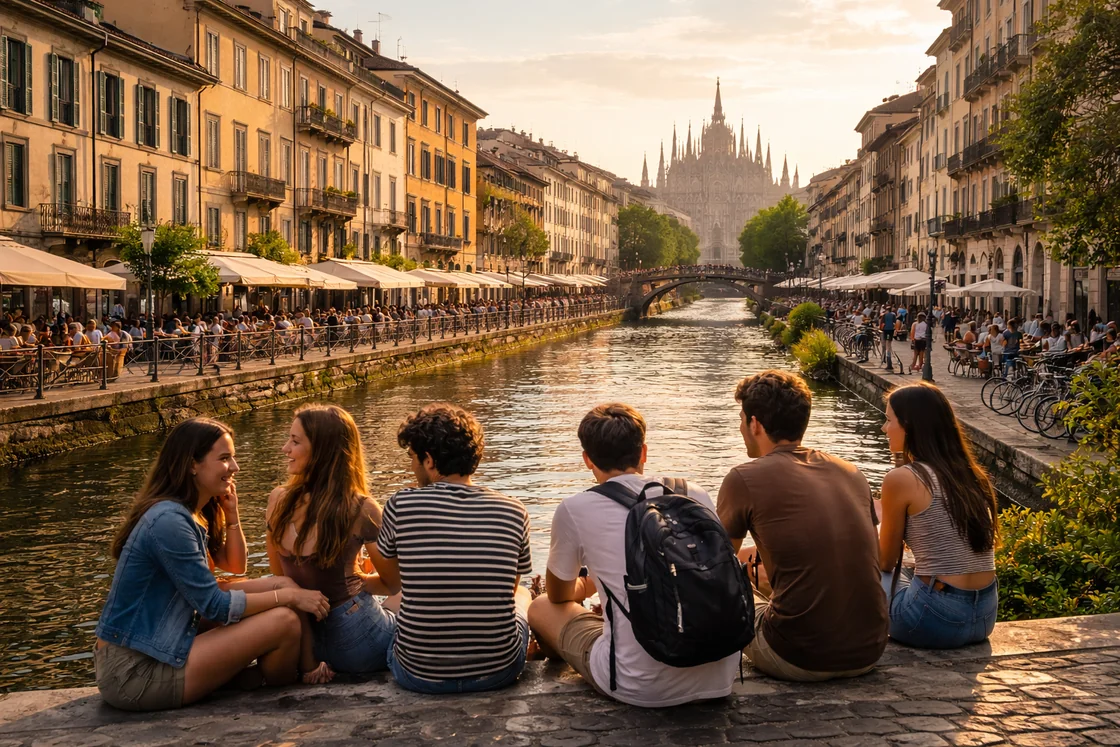
Navigli is one of the clearest social zones for students in Milan. It works well for aperitivo, casual evenings and nights where meeting people feels easier because movement happens naturally between bars, canals and group plans.
Understand Milan's dispersed student scene, compare the areas that shape daily life and nightlife, and learn how events and repeated routines make the city easier to navigate.
Milan is one of the strongest Erasmus destinations in Italy for students who want a city with more scale than the classic university-centered model. The city mixes major universities, international student flows, nightlife, creative neighborhoods and professional energy in a way that makes student life feel broader and less enclosed than in smaller destinations.
That makes Milan attractive for Erasmus and international students who do not only want campus routines. The city can give you more variety in the kind of people you meet, the types of events you find and the neighborhoods you end up using, but it also asks for more intention in the first weeks because social life is more spread out.
In practical terms, Milan is best for students who want a bigger city, more nightlife formats and a broader international mix. You may prefer Bologna if you want a denser and more immediately student-centered routine, Rome if you want a larger cultural backdrop with more city movement, or Florence if you want a more compact and polished setting.
If you want the wider map first, start from the Erasmus cities hub or return to the Unera homepage. For the practical side of settling in, read how to meet Erasmus students, how to make friends during Erasmus and how to make friends abroad. If you are comparing tools for the social side of Erasmus, see the best app for Erasmus students.
Milan works especially well as a comparison city because it shows what changes when student life is less concentrated and more city-wide. If you want to compare it directly, also open Erasmus in Bologna and Erasmus in Rome.
Student life in Milan feels broader than in most Italian Erasmus cities because it is not shaped by one dominant student core. Universities, nightlife areas, aperitivo culture, internships, design events and international communities all overlap, but they do so across different neighborhoods and rhythms.
The advantage is range. In Milan you can move between casual student routines, more international social circles, cultural events, larger nightlife scenes and neighborhood-specific habits without feeling locked into one version of city life.
The tradeoff is that Milan rarely gives you an instant social map. Students who do well here are usually the ones who understand early which areas matter for them, which events are worth repeating and how to turn a large city into a smaller routine.
Navigli is one of the clearest social zones for students in Milan. It works well for aperitivo, casual evenings and nights where meeting people feels easier because movement happens naturally between bars, canals and group plans.
Citta Studi is one of the most important daily student zones in Milan, especially around Politecnico and Statale. It matters more for routine, daytime movement and repeated student contact than for destination nightlife.
Porta Venezia has a more international and mixed atmosphere, useful for students who want nightlife, social variety and a neighborhood that feels connected to a broader city crowd.
Isola gives you a more contemporary and creative version of Milan. It is useful for students who want a different social tone from the classic student districts and who like a more design-oriented city atmosphere.
Politecnico is one of the main institutions shaping the student presence in Milan. It contributes heavily to the international mix and to the daily rhythm of areas like Citta Studi.
The University of Milan adds scale and student density across different parts of the city, making it a major source of academic and social movement.
Bocconi adds a different student profile to the city, with a strong international and professional orientation that influences nearby neighborhoods and social circles.
Milano-Bicocca expands the city's university ecosystem and strengthens Milan's role as a destination with multiple student entry points rather than a single core.
Milan has one of the strongest event layers in the Italian Erasmus cluster, but volume alone does not make discovery easy. Students often face a mix of nightlife promoters, university circles, aperitivo events, international meetups and private chat groups that do not connect well to each other.
This is why event discovery in Milan works better when you understand the city in layers rather than as one scene. If you want a more specific page focused on that search intent, open student events in Milan. It complements this page by going deeper into where students actually go and how the city event map behaves.
The students who get the most out of Milan usually do not chase every event. They find a few neighborhoods, formats and recurring nights that fit their style, then use those as anchors for repeated contact.
This is the critical section because Milan is not difficult socially in the same way smaller cities are. It is a city where meeting people becomes easier once you know how to reduce spread and repetition actually starts working for you.
In Milan, it helps to focus early on areas where student movement repeats. Navigli, Citta Studi and Porta Venezia matter because they give you more than one chance to see the same kind of social energy.
A student event in Milan is most useful when it helps you understand which part of the city fits you, not only when it gives you one good night. For the broader process, read how to meet Erasmus students.
Milan offers a lot of options, but too much novelty can slow social momentum. This is why making friends during Erasmus often works better when you return to the same neighborhoods, same formats and same people more than once.
Milan becomes easier when you combine real neighborhoods with something that helps you see nearby students and relevant plans. Unera helps reduce the friction between discovery, timing and follow-up in a city that otherwise feels scattered.
Nightlife in Milan is one of the city's biggest advantages for Erasmus students, but it is not one single scene. Aperitivo culture, casual bar nights, larger clubs, design-oriented spaces and neighborhood-specific habits all shape how students go out.
That makes Milan especially good for students who want variety and the freedom to choose different social formats during the semester. The city can support both low-pressure evenings and more ambitious nightlife, depending on where you spend time.
The important point is that nightlife in Milan works best when it connects to a broader routine. If you understand which neighborhoods fit you socially, nightlife becomes a repeated part of student life rather than a disconnected search for the next plan.
Milan feels easier once you stop treating it like one city and start treating it like a set of usable student zones. Pick a few areas that match your university, your evenings and your social style.
The first weeks matter because Milan can feel exciting and dispersive at the same time. The best moment to use how to make friends abroad is before the city turns into passive browsing instead of repeated contact.
Milan is best for students who want more scale, more variety and a broader international mix. If you want a denser and easier student routine, Bologna may fit better. If you want a larger cultural backdrop and a more historic city rhythm, Rome can be a better match.
Milan gives you range, but not always clarity. Unera helps you understand who is nearby and socially relevant instead of leaving everything to random timing across a large city.
The app helps reduce one of Milan's biggest frictions: too many fragmented channels for events, plans and student meetups. Events and people become easier to discover in one flow.
Milan rewards students who can turn first contact into repetition. Unera helps you keep momentum after the first event, aperitivo or conversation, which is what makes a bigger city start to feel socially manageable.
Use Unera to discover students, find events and turn your first weeks in Milan into real momentum.