


Portello
Portello is one of the clearest student reference points in Padova. It matters for bars, after-class movement, water-side university atmosphere and the kind of regular visibility that helps Erasmus students feel the city quickly.
Padova gives Erasmus students one of Italy's clearest university-city experiences, with visible academic life, bike-friendly routines and a social map that works fast once you use the right student areas.
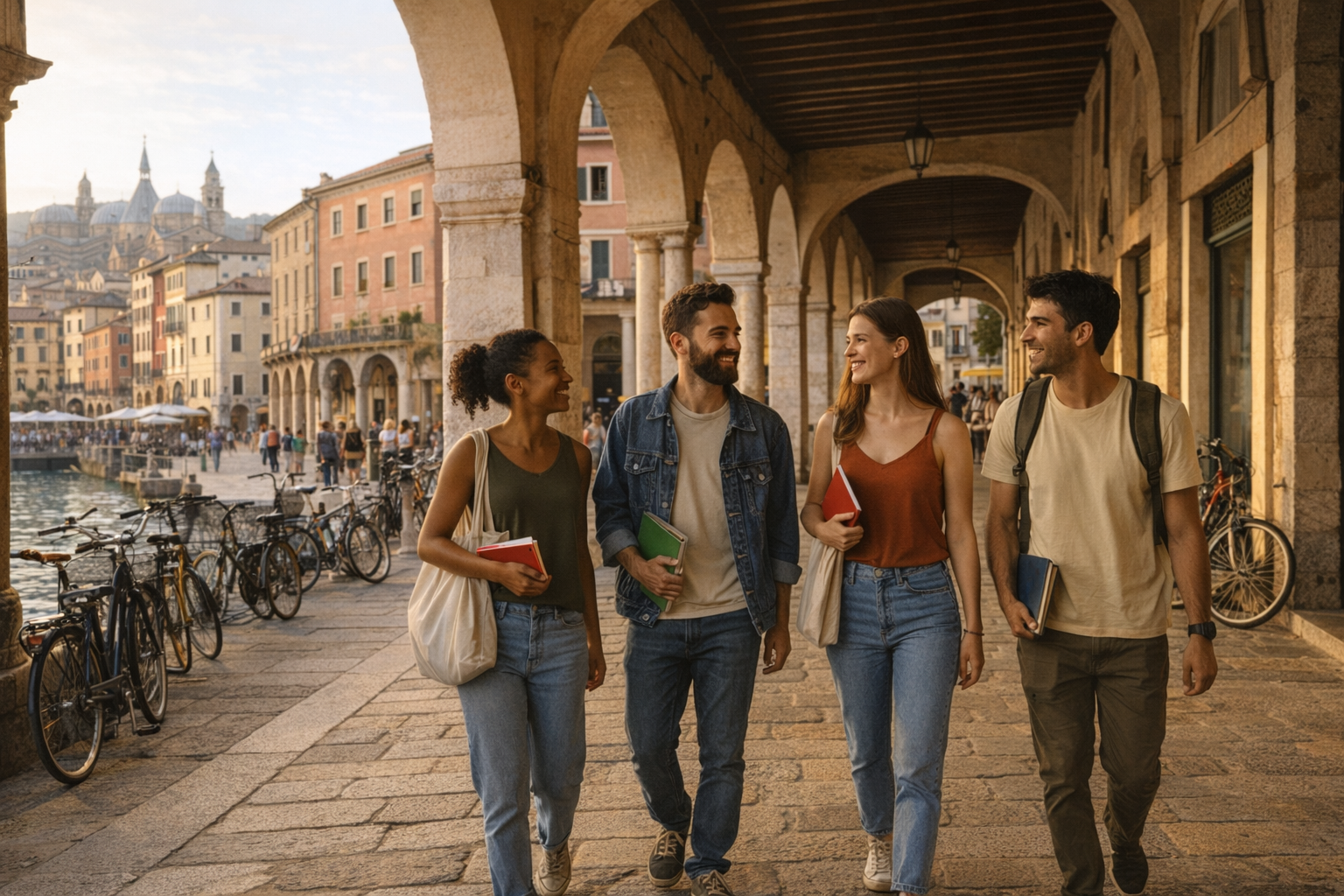
Padova is one of the strongest Erasmus cities in Italy for students who want a serious university environment without giving up daily social life. The University of Padua is deeply embedded in the city, which means student routines, bike movement, bars and study habits overlap more naturally than in many larger places.
That makes Padova attractive for Erasmus and international students who want more academic weight than a small town, but less dispersion than Milan or Rome. You may prefer Pavia if you want a quieter college-town rhythm, Genova if you want a more urban coastal map or Bologna if you want the most obvious student density from the first week.
In practice, Padova works through Portello, the central piazzas, bike or tram routines, welcome activity, student associations and simple after-class plans that become repeated habits quickly. The city feels easier once you stop treating it as a tourist stop near Venice and start reading it as a real university ecosystem.
If you want the wider map first, start from the Erasmus cities hub, the Erasmus Italy pillar or return to the Unera homepage. For the practical side of arrival, read how to meet Erasmus students, how to make friends during Erasmus and how to make friends abroad. If you are comparing tools for the social side of exchange, see the best app for Erasmus students.
Student life in Padova feels visible because the university is everywhere: in the center, around Portello, in the bars, in the bike routes and in the rhythm of the day. You do not need to search hard to notice that the city is built around students.
A realistic Erasmus week in Padova often mixes lectures, student-card errands, bike or tram routines, aperitivo near the center, Portello evenings, Prato della Valle plans and welcome or association events that create familiar circles quickly.
Padova is slightly less immediately nightlife-dense than Bologna, larger and more active academically than Pavia and more university-centered than Genova. It is strongest for students who want serious academic energy with a still-manageable social map.
Real student behavior in Padova is practical: use the first welcome infrastructure, learn your main route between faculty and center, keep returning to the same bars or squares and build momentum before housing or paperwork fatigue slows you down.
Portello is one of the clearest student reference points in Padova. It matters for bars, after-class movement, water-side university atmosphere and the kind of regular visibility that helps Erasmus students feel the city quickly.
The center around Piazza delle Erbe, Piazza della Frutta and nearby streets works for aperitivo, evenings, errands and the everyday movement that makes student life feel naturally integrated.
Useful for students who want open-air plans, calmer walks, bike movement and a strong bridge between central life and residential routine.
Important for students whose daily life is shaped by larger university buildings outside the old core. Housing and transport choices feel different here than in the postcard center.
Not the romantic answer, but relevant for budget, transport and students who need a more functional base while staying connected to the center by bike or tram.
The University of Padua is the main Erasmus anchor in the city. Its scale, academic reputation and international services create one of the strongest study-abroad ecosystems in Italy.
The historical university core matters because it keeps academic life physically tied to the center. That is one reason Padova feels more student-led than many cities of similar size.
These routes shape the science, economics and large-faculty side of the city. They matter because many incoming students will feel Padova first through these practical university paths.
Padova also has a music and cultural student presence that adds concerts, artistic circles and another entry point beyond the biggest university faculties.
Padova has a strong Erasmus event layer, but students still find the best plans through Welcome Days, Welcome Fair activity, guided tours, buddy systems, ESN Padova, department groups, student associations and repeated after-class habits rather than one perfect nightlife listing.
The strongest entry points are welcome events, language exchange, aperitivo around Portello or the center, running dinners, city walks, association nights and outdoor plans when the weather makes Padova feel almost like a giant student courtyard.
What matters most is follow-up. In Padova, a good first week can create momentum very quickly if you turn one event into a second plan. For the broader method, use how to meet Erasmus students before the semester gets lost in logistics.
Padova is socially accessible, but the city works best when you use its welcome infrastructure and student zones early rather than drifting through admin tasks for too long.
Padova gives incoming students one of the clearest official entry layers in Italy. Use it. The first guided tours, fairs and association moments create names and routes that make the city easier immediately.
Portello is useful because it connects class life, easy drinks and repeated student movement. It is one of the fastest ways to feel how the city actually works.
A coffee, aperitivo, Prato walk or bike ride can do more than waiting for a giant party. For the broader process, read how to make friends during Erasmus.
Padova has enough students that people can disappear into parallel groups quickly. Unera helps nearby students, interests and events stay visible so good first contact becomes real follow-up.
Nightlife in Padova is more student-led than many visitors expect. Portello, the central piazzas, the Ghetto area and warm-weather outdoor plans create a real social circuit without needing a giant-capital scale.
That makes the city good for students who want repeated encounters, mixed groups and a balance between academic seriousness and evening social life. Padova is usually more about routine than about spectacle.
The best approach is to let nightlife extend the university day rather than replace it. When classes, aperitivo, squares and repeated student areas connect, Padova feels easy very quickly.
Padova has strong incoming demand. Start early, confirm where your faculty actually is and choose between center, Portello or more practical outer areas with open eyes.
The city becomes much easier once you understand what is realistically bikeable and where the tram helps. Transport choices shape social life here more than many students expect.
Student cards, registrations and orientation all matter, but social momentum matters too. Use small plans early while you still have room to build routine.
Choose Padova if you want one of Italy's clearest university-city ecosystems. Choose Pavia for a smaller collegiate town, Genova for an urban coastal semester or Bologna for denser student-nightlife intensity.
Padova has a lot of incoming students, which is useful but can also feel dispersed. Unera helps nearby people and interests become visible faster.
Welcome fairs and first-week events are only useful if they become follow-up. Unera helps students turn those first meetings into chat, plans and repeated contact.
Padova works because academic life and social life stay connected. Unera makes that connection easier to use. Start from the Erasmus student app page for the product view.
Use Unera to discover students, find events and turn your first weeks in Padova into real momentum.