


Strada Nuova and Piazza Leonardo da Vinci
This is one of the clearest university references in Pavia. It gives you lectures, student foot traffic, easy cafes and the kind of central movement that helps a new student understand the city fast.
Pavia gives Erasmus students a compact university town with college culture, low-friction daily life and a social rhythm that grows through repeated contact more than through big-city intensity.
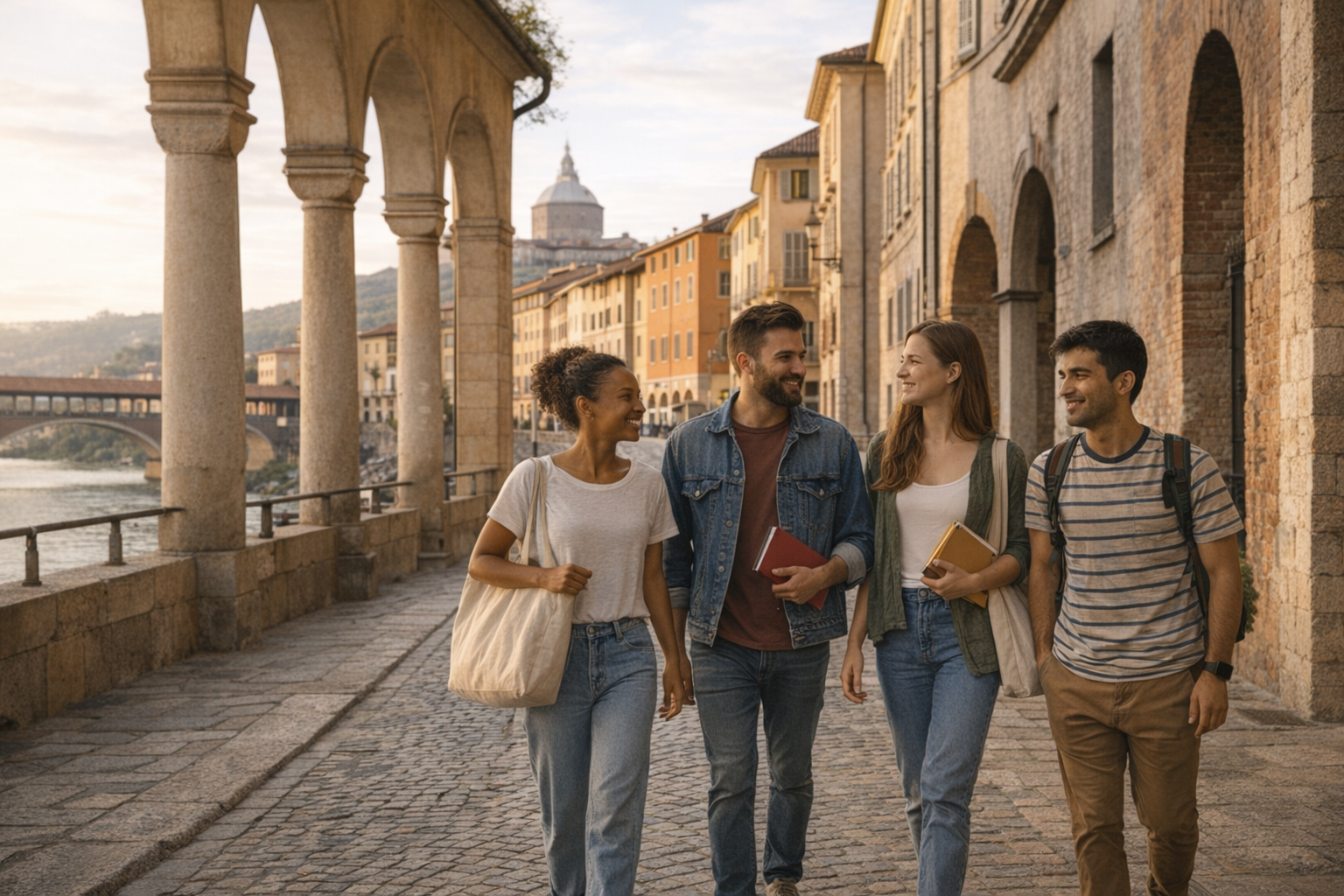
Pavia is one of the clearest Erasmus options in Italy for students who want a real university town instead of a huge metropolitan semester. The historic center, the colleges, the river and the university routines sit close enough together that student life becomes visible very quickly.
That makes Pavia attractive for Erasmus and international students who want something calmer than Milan without feeling isolated. You may prefer Padova if you want a bigger and more crowded academic city, Perugia if you want a hilltop international-language atmosphere, or Bologna if you want stronger nightlife density from the first week.
In practice, Pavia works through repeated habits: lectures, college courtyards, aperitivo in the center, riverside walks, smaller parties, student associations and simple plans that happen again. The city rewards continuity more than scale, which is exactly why many students find it easier socially than bigger places.
If you want the wider map first, start from the Erasmus cities hub, the Erasmus Italy pillar or return to the Unera homepage. For the practical side of arrival, read how to meet Erasmus students, how to make friends during Erasmus and how to make friends abroad. If you are comparing tools for the social side of exchange, see the best app for Erasmus students.
Student life in Pavia works because the city is manageable. You can walk, bike, recognize the same people and build familiarity through ordinary routines instead of depending on a large anonymous scene.
A realistic Erasmus week in Pavia often mixes lectures, aperitivo around the center, college dinners or events, riverside time near the Ticino, informal house gatherings and small trips that never fully replace the city itself.
Pavia is smaller and calmer than Padova, flatter and more college-shaped than Perugia and less instantly nightlife-heavy than Bologna. It is strongest for students who want an academic town where repeated contact matters more than crowd size.
Real student behavior in Pavia is simple and effective: say yes to the first welcome plans, use the colleges and courtyards as bridges, keep returning to the same bars and let the city's smaller scale work in your favor.
This is one of the clearest university references in Pavia. It gives you lectures, student foot traffic, easy cafes and the kind of central movement that helps a new student understand the city fast.
The old center works for aperitivo, errands, evening movement and repeated plans that stay low-pressure. It is the easiest social anchor for students who are still learning the town.
This side matters for walks, warmer-weather plans, bridge-to-river routines and a more relaxed social pace. It is especially useful once you already know people and want second or third plans.
The historic colleges shape Pavia student life more than many Erasmus arrivals expect. Even if you do not live inside them, the surrounding streets and social routines matter to the city ecosystem.
Students connected to science, engineering or health routines need to think beyond the postcard center. This side changes housing, commuting and the daily map of who you naturally see.
The University of Pavia is the main Erasmus anchor in the city. Its international office, long academic tradition and compact urban integration define the semester for most incoming students.
IUSS adds an honors and advanced-study layer that strengthens Pavia's academic identity. It contributes to the city's reputation as a serious but still social university environment.
Ghislieri is one of the institutions that makes Pavia feel different from many Erasmus cities. The college tradition influences study culture, events and the social architecture of the city.
Borromeo is another major part of the collegiate ecosystem. It matters because Pavia student life often grows through institutions and courtyards, not only through nightlife streets.
Pavia has a real Erasmus event layer, but the best plans are usually filtered through the University of Pavia welcome system, local buddies, college circles and ST.E.P. ESN Pavia rather than through one giant event page.
Welcome activities, tandem or language exchange, college events, aperitivo, riverside plans and smaller international evenings tend to work best because they create actual follow-up. That is one of the benefits of Pavia: a decent event can become a repeated circle quickly.
The mistake is using Milan as your only social answer. Pavia is stronger when students use Milan occasionally but build their weekly rhythm locally. For the broader method, use how to meet Erasmus students before arrival turns into drift.
Pavia is one of the easier Italian cities for meeting people when you respect the college-and-routine logic instead of waiting for one big event to fix everything.
The first University of Pavia information, local buddies and ESN contacts matter because they plug you directly into a smaller social ecosystem where names and faces repeat.
Even if you are not in a college, student life often passes through college-related circles. Shared dinners, courtyards and word-of-mouth events are part of the city rhythm.
Coffee after class, aperitivo, a short walk by the Ticino or a low-pressure evening can do more than waiting for a perfect party. For the broader process, read how to make friends during Erasmus.
In a smaller city, proximity matters a lot. Unera helps nearby students, interests and plans become visible so Pavia does not depend only on closed group chats.
Nightlife in Pavia is smaller and more social than in Italy's biggest Erasmus cities. Students usually move through aperitivo, bars in the center, college events, house parties and riverside or bridge-area plans rather than one giant club circuit.
That is not a weakness if your goal is actually to build friendships. Pavia is strong precisely because people keep seeing each other and the same places become familiar quickly.
The only real mistake is assuming the city is too quiet before you have built routine. In Pavia, repeated small plans are often the real social engine, not one spectacular night out.
The center looks easy because Pavia is small, but where you study still matters. Check whether you need the old center, the colleges or the scientific side before deciding.
Pavia becomes much easier once you accept that it is a walkable or bikeable city. The smaller scale is one of the reasons students settle socially faster here.
The train connection is useful, but your semester gets stronger when the weekly rhythm stays local and Milan becomes an occasional extra rather than an escape.
Read the university welcome material, join the first buddy or ESN moments and use small plans quickly. If you feel stuck, read how to make friends abroad while the semester is still early.
Pavia is compact, which means nearby people and recurring plans matter a lot. Unera makes that proximity easier to use instead of leaving it to chance.
The city rewards repeated contact. Unera helps students turn a welcome evening, college dinner or river plan into ongoing conversation and a second plan.
Pavia is strongest when academic routine and student life stay connected. Unera helps link classes, interests and events into one usable social map. Start from the Erasmus student app page for the product view.
Use Unera to discover students, find events and turn your first weeks in Pavia into real momentum.